
$

PAUS ID

Padjadjaran Authentication System.

$

Portal Mahasiswa

Merupakan portal informasi bagi mahasiwa UNPAD

$

Portal Staff

Merupakan portal informasi bagi staf UNPAD.

$

Email UNPAD

Layanan email berbasis Google App for Education (GAFE) bagi seluruh sivitas akademika Unpad.

UNPAD

Neutrophil Gelatinase-Associated Lipocalin as a Useful Modality in Early Acute Kidney Injury Detection Amongst Low-Birth-Weight Neonates

Neutrophil Gelatinase-Associated Lipocalin as a Useful Modality in Early Acute Kidney Injury Detection Amongst Low-Birth-Weight Neonates

39

Autors
Tetty Yuniati 1, Fiva Aprilia Kadi 1, Aris Primadi 1, Dwi Oktari Erfanti 2, Johanes Edy Siswanto 3,4 and Ahmedz Widiasta 5,


Affiliations

1 Neonatology Division, Child Health Department, Faculty of Medicine, Universitas Padjadjaran, Hasan Sadikin General Hospital, Bandung 40161, Indonesia 2 Neonatology Division, Child Health Department, Faculty of Medicine, Universitas Padjadjaran Hospital, Jatinangor 45363, Indonesia 3 Department of Neonatology, Harapan Kita National Woman and Children’s Hospital, Jakarta 11420, Indonesia 4 Faculty of Medicine, Pelita Harapan University, Tangerang 15811, Indonesia 5 Nephrology Division, Child Health Department, Faculty of Medicine, Universitas Padjadjaran, Hasan Sadikin General Hospital, Bandung 40161, Indonesia

Background

• Serum creatinine, the routine marker for acute kidney injury (AKI), rises late.

• An earlier biomarker is needed, especially in neonates.

Methods

• Prospective cohort of preterm neonates (28–34 weeks’ gestation) at Hasan Sadikin General Hospital, Bandung.

• Serum NGAL and creatinine were measured, and the association with AKI in the first 48 hours was tested with Spearman’s correlation.

Key Results

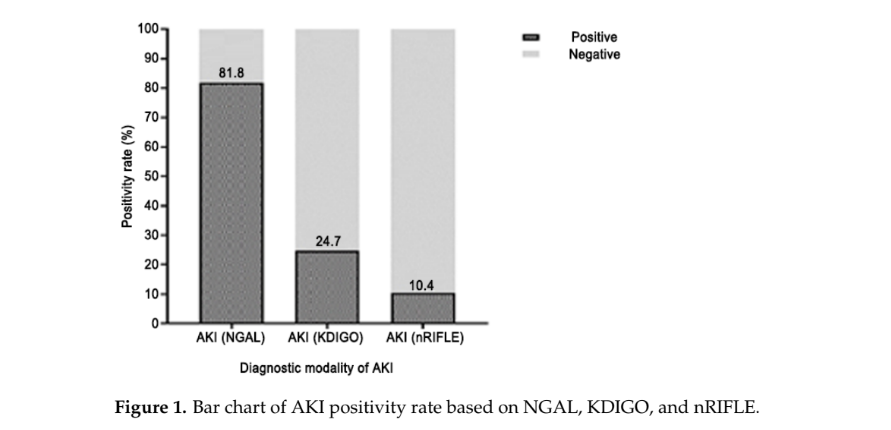
• NGAL had a much higher positivity rate for early AKI (81.8%) than creatinine by KDIGO (24.7%) or nRIFLE (10.4%) criteria.

Discussion & Conclusion

• NGAL can be used as a modality to detect AKI earlier in neonates.

• Earlier detection could help protect long-term kidney health.

Related SDGs

SDG 3: Good Health and Well-Being – Improving early detection of kidney injury in newborns

Journal Information

Journal: Kidney and Dialysis
DOI: https://doi.org/10.3390/kidneydial6010014

Tempeh and microalgae-fortified tempeh exhibit anti cancer potential through S-phase arrest and EGFR/PI3K/AKT/mTOR pathway modulationin BT-474 breast cancer cells

Tempeh and microalgae-fortified tempeh exhibit anti cancer potential through S-phase arrest and EGFR/PI3K/AKT/mTOR pathway modulationin BT-474 breast cancer cells

38

Authors
Hesti Lina Wiraswati a,b,* , Nur Akmalia Hidayati c , Ilma Fauziah Ma’ruf d, Julia Ramadhanti a,b, Enny Rohmawaty a,b, Vira Putri Yarlina e, Ardimas Andi Purwita f, Kengo Suzuki g,h, Keiichi Mochida i

Affiliations

a Department of Biomedical Sciences, Faculty of Medicine, Universitas Padjadjaran, Sumedang, West Java, Indonesia b Oncology and Stem Cell Working Group, Faculty of Medicine, Universitas Padjadjaran, Bandung, West Java, Indonesia c Research Center for Applied Microbiology, National Research and Innovation Agency, Bogor, Indonesia d Research Center for Pharmaceutical Ingredients and Traditional Medicine, National Research and Innovation Agency, Bogor, West Java, Indonesia e Department of Food Industrial Technology, Universitas Padjadjaran, Bandung, Indonesia. f Department of Computer, Electrical and Mathematical Sciences and Engineering, King Abdullah University of Science and Technology (KAUST), Saudi Arabia g Euglena Co., Ltd., Tokyo, Japan h RIKEN Baton Zone Program, Yokohama, Japan i RIKEN Center for Sustainable Resource Science, Yokohama, Japan

Background

• Tempeh is a traditional fermented soybean food with nutritional and functional value.

• Microalgae have diverse anticancer activities and may enhance tempeh through fortification.

Methods

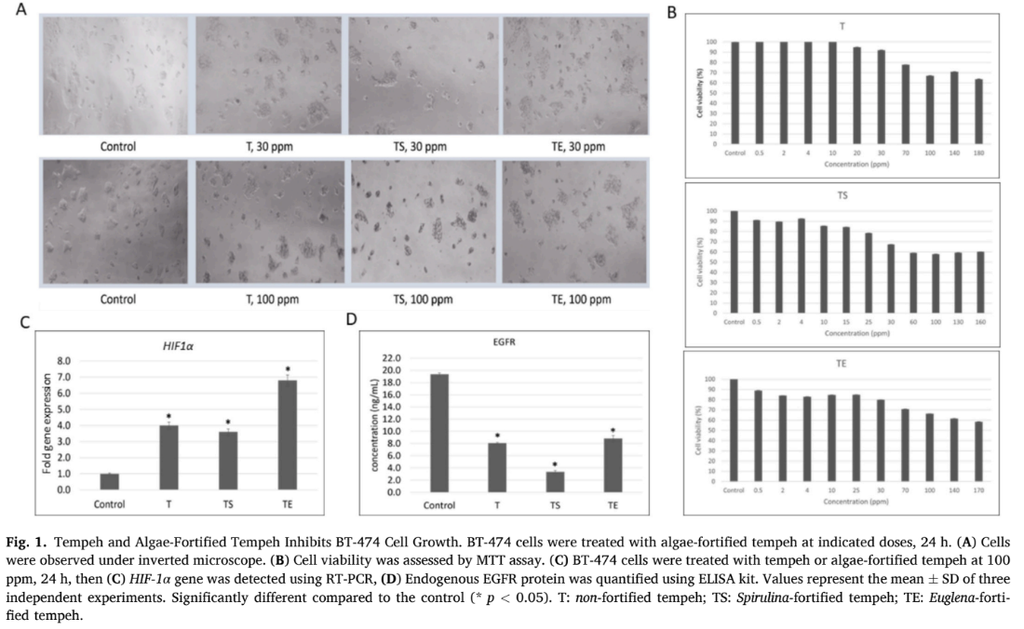
• Extracts of tempeh and algae-fortified tempeh were tested on BT-474 luminal B breast cancer cells.

• Phytochemical analysis, cell viability, gene expression, and flow cytometry were used.

Key Results

• Extracts contained flavonoids, alkaloids, and high phenolic content.

• Algae-fortified tempeh reduced cell viability by up to 60%, more than conventional tempeh.

• All extracts suppressed EGFR, induced S-phase arrest, and modulated the PI3K/AKT/mTOR pathway.

Key Results

•Extracts contained flavonoids, alkaloids, and high phenolic content.

•Algae-fortified tempeh reduced cell viability by up to 60%, more than conventional tempeh.

•All extracts suppressed EGFR, induced S-phase arrest, and modulated the PI3K/AKT/mTOR pathway.

Discussion & Conclusion

• Algae fortification is a food-biotechnology strategy for pathway-targeted cancer prevention.

• These are laboratory findings in cancer cells; they support complementary health applications.

Related SDGs

SDG 2: Zero Hunger – Innovation in nutritious functional foods

SDG 3: Good Health and Well-Being – Exploring food-based approaches to cancer prevention

Journal Information

Journal: Journal of Functional Foods

DOI: https://doi.org/10.1016/j.jff.2026.107158

Pregnancy Outcomes in Women Aged 20–34 vs. ≥35 Years:A Cross-Sectional Study in a Tertiary Referral Center

Pregnancy Outcomes in Women Aged 20–34 vs. ≥35 Years:A Cross-Sectional Study in a Tertiary Referral Center

37

Authors
Farsyah Septrial Hendra Syahputra1, Adhi Pribadi2, Dini Hidayat2, Eppy Darmadi Achmad2, Andi Kurniadi2

Affiliations
1Faculty of Medicine, Universitas Padjadjaran, Bandung, 2Department of Obstetrics and Gynecology Universitas Padjadjaran Dr. Hasan Sadikin Hospital Bandung

Background

• Advanced maternal age is often linked to pregnancy complications.

• This study compared pregnancy outcomes between women aged 20–34 and those aged 35 or older.

Methods

• Cross-sectional study of 150 patients at Dr. Hasan Sadikin General Hospital in 2022.

• Data were analysed with chi-square and Cochran-Mantel-Haenszel tests.

Key Results

• Women aged 35 or older had significantly higher rates of operative delivery (OR 2.16).

• Hypertensive disorders (OR 3.95) and postpartum hemorrhage (OR 2.93) were also more common.

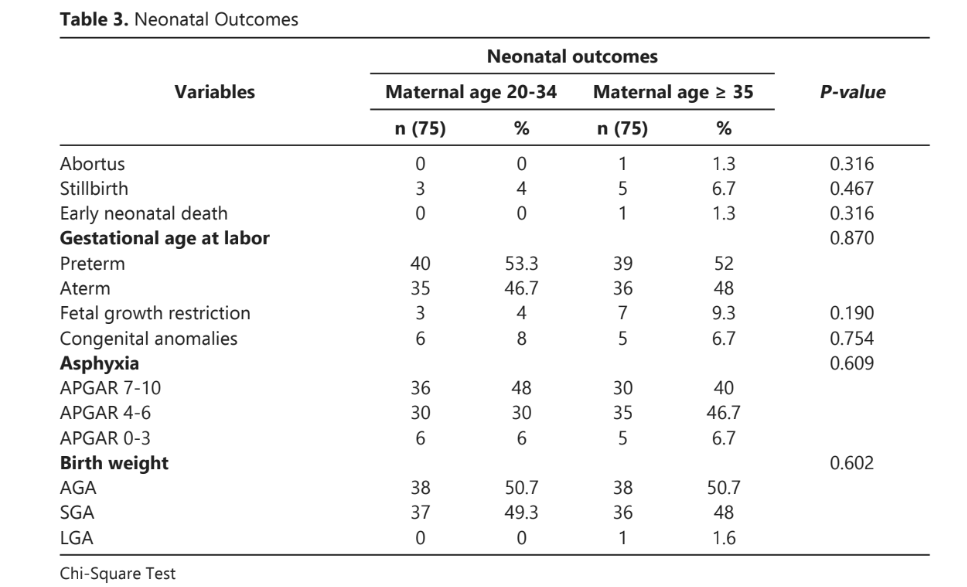
• Neonatal outcomes did not differ significantly between the age groups.

Discussion & Conclusion

• Advanced maternal age is associated with adverse maternal outcomes.

• Neonatal outcomes appear comparable between age groups.

Related SDGs

SDG 3: Good Health and Well-Being – Improving maternal health and safe childbirth

Journal Information

Journal: Indonesian Journal of Obstetrics and Gynecology

DOI: https://doi.org/10.32771/inajog.v14i1.2460

The Paradox of Stunting: Differences in the Perception of Health Workers in Community Health Centers and Experts in Hospitals on Low Birth Weight and Stunting Data

The Paradox of Stunting: Differences in the Perception of Health Workers in Community Health Centers and Experts in Hospitals on Low Birth Weight and Stunting Data

36
Authors
Alma Lucyati 1,2, Deni Kurniadi Sunjaya 3, Gaga Irawan Nugraha 4,Dewi Marhaeni Diah Herawati 3, Dida Akhmad Gurnida4,5, Dedi Rachmadi5

Affiliations
1Doctoral Study Program, Faculty of Medicine, Universitas Padjadjaran, Bandung, Indonesia; 2 Department of Public Health, Faculty of Medicine, Universitas Pasundan, Bandung, Indonesia; 3 Department of Public Health, Faculty of Medicine, Universitas Padjadjaran, Bandung, Indonesia; 4 Department of Biomedical Sciences, Faculty of Medicine, Universitas Padjadjaran, Bandung, Indonesia; 5 Department of Pediatrics, Faculty of Medicine, Universitas Padjadjaran, Bandung, Indonesia

Background

• Health workers at community health centers (CHCs) and hospital experts may interpret low birth weight (LBW) and stunting data differently.

• This study used community-based nutrition reporting data (e-CBNRR) to compare their perceptions.

Methods

• Mixed-methods study.

• Quantitative: e-CBNRR data from 2020 to 2024, covering 715 children (287 LBW and 428 non-LBW) in 141 sub-districts.

• Qualitative: in-depth interviews analysed thematically, using the quantitative results as a starting point.

Key Results

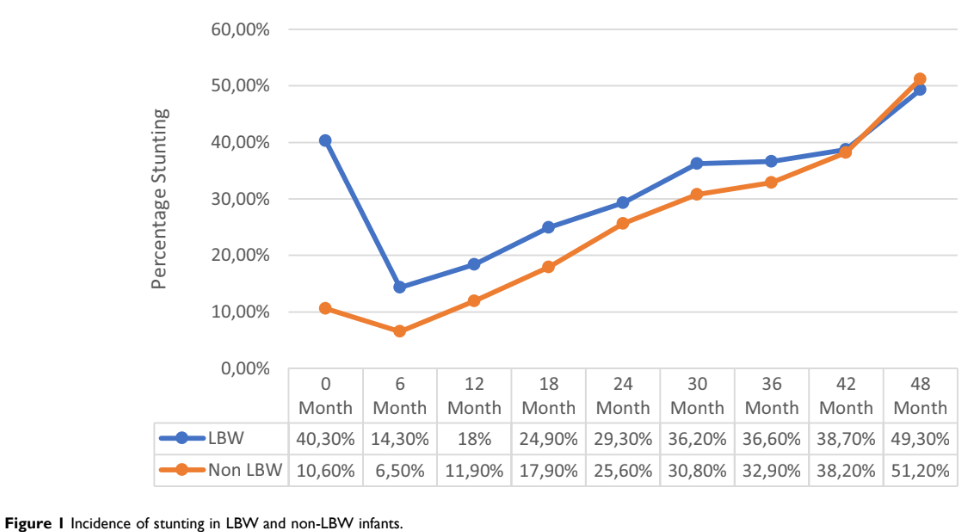
• Stunting at birth reached 40.30% in the LBW group versus 10.60% in the non-LBW group.

• In the LBW group, stunting fell to 14.30% at 6 months but rose again with age; in the non-LBW group it climbed to 51.20% at 48 months.

• CHC health workers had never conducted advanced analysis of e-CBNRR data and did not link the data to the interventions needed.

Discussion & Conclusion

• LBW babies had stunting rates about 4 times higher than non-LBW babies, and stunting declined during breastfeeding before rising again as children grew.

• Perceptions differ between CHC health workers and hospital experts; e-CBNRR data can help develop better-targeted interventions for LBW and stunting.

Related SDGs

SDG 2: Zero Hunger – Tackling child stunting and undernutrition

SDG 3: Good Health and Well-Being – Strengthening maternal and child health services

Journal Information

Journal: Journal of Multidisciplinary Healthcare

DOI: https://doi.org/10.2147/JMDH.S563847

Contribution of Immune Responses to Aedes aegypti Saliva in Dengue Severity Among Patients with Atopic Dermatitis

Contribution of Immune Responses to Aedes aegypti Saliva in Dengue Severity Among Patients with Atopic Dermatitis

35

Authors
Ratna Dewi Indi Astuti1,2,*, Anggraini Alam3,*, Mohammad Ghozali 4,*, Budi Setiabudiawan 3,5,*

Affiliations
1Doctoral Study Program, Faculty of Medicine, Universitas Padjadjaran, Bandung, West Java, 40161, Indonesia; 2 Department of Microbiology-Parasitology of Faculty of Medicine, Universitas Islam Bandung, Bandung, West Java, 40116, Indonesia; 3Department of Child Health of Faculty of Medicine, Universitas Padjadjaran & Hasan Sadikin General Hospital, Bandung, West Java, 40161, Indonesia; 4 Department of Biomedical Sciences of Faculty of Medicine, Universitas Padjadjaran, Bandung, West Java, 40161, Indonesia; 5 Faculty of Medicine, President University, Cikarang Bekasi, West Java, 17550, Indonesia

Background

• Dengue severity is shaped by viral load and the host’s immune response.

• Aedes aegypti saliva increases cell numbers at the bite site, which may promote viral replication.

• Atopic dermatitis (AD) involves hypersensitivity to Aedes saliva and a Th2-skewed immune response, and both AD and severe dengue are more common in children.

Methods

• Observational cross-sectional study of 62 children aged 1–12 years with secondary dengue.

• AD history was assessed with the ISAAC questionnaire.

• T-cell function was measured as IFNγ, IL-10, IL-13, and CCL2 levels in stimulated whole blood cultures, with and without Aedes aegypti salivary gland extract (SGE), using ELISA.

Key Results

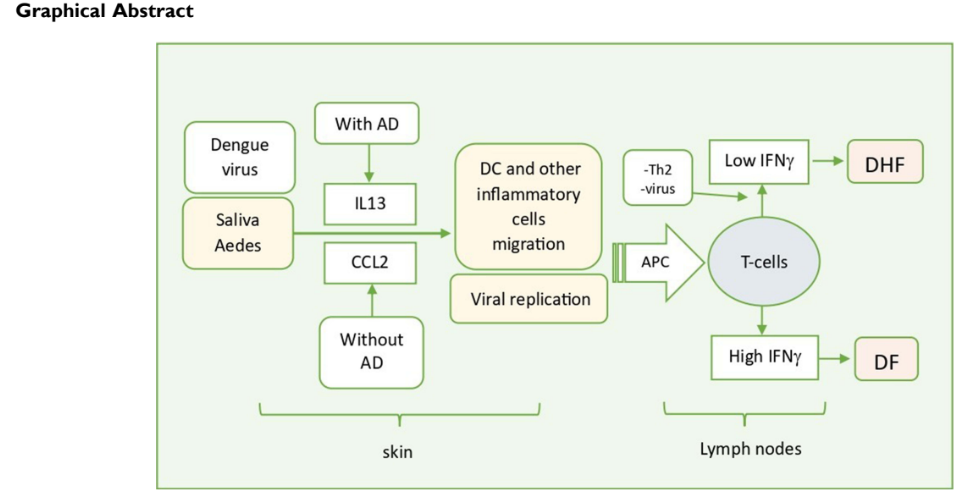
• Dengue hemorrhagic fever (DHF) was more common in dengue patients with AD than in those without AD (p = 0.010).

• With SGE, CCL2 was higher in DHF than in dengue fever (p = 0.044), and IL-13 was higher in patients with AD (p = 0.026).

• Without SGE, IFNγ was lower in DHF than in dengue fever (p = 0.035).

Discussion & Conclusion

• AD may be linked to a higher incidence of DHF and greater T-cell IL-13 production in response to Aedes saliva.

• Higher CCL2 in DHF may reflect greater cell infiltration at the bite site, while lower IFNγ suggests a weaker T-cell response to dengue infection.

Related SDGs

SDG 3: Good Health and Well-Being – Understanding immune factors behind severe dengue in children

Journal Information

Journal: Journal of Inflammation Research

DOI: https://doi.org/10.2147/JIR.S580550

Pin It on Pinterest