

Authors
Hesti Lina Wiraswati a,b,* , Nur Akmalia Hidayati c , Ilma Fauziah Ma’ruf d, Julia Ramadhanti a,b, Enny Rohmawaty a,b, Vira Putri Yarlina e, Ardimas Andi Purwita f, Kengo Suzuki g,h, Keiichi Mochida i
Affiliations
a Department of Biomedical Sciences, Faculty of Medicine, Universitas Padjadjaran, Sumedang, West Java, Indonesia b Oncology and Stem Cell Working Group, Faculty of Medicine, Universitas Padjadjaran, Bandung, West Java, Indonesia c Research Center for Applied Microbiology, National Research and Innovation Agency, Bogor, Indonesia d Research Center for Pharmaceutical Ingredients and Traditional Medicine, National Research and Innovation Agency, Bogor, West Java, Indonesia e Department of Food Industrial Technology, Universitas Padjadjaran, Bandung, Indonesia. f Department of Computer, Electrical and Mathematical Sciences and Engineering, King Abdullah University of Science and Technology (KAUST), Saudi Arabia g Euglena Co., Ltd., Tokyo, Japan h RIKEN Baton Zone Program, Yokohama, Japan i RIKEN Center for Sustainable Resource Science, Yokohama, Japan
Background
• Tempeh is a traditional fermented soybean food with nutritional and functional value.
• Microalgae have diverse anticancer activities and may enhance tempeh through fortification.
Methods
• Extracts of tempeh and algae-fortified tempeh were tested on BT-474 luminal B breast cancer cells.
• Phytochemical analysis, cell viability, gene expression, and flow cytometry were used.
Key Results
• Extracts contained flavonoids, alkaloids, and high phenolic content.
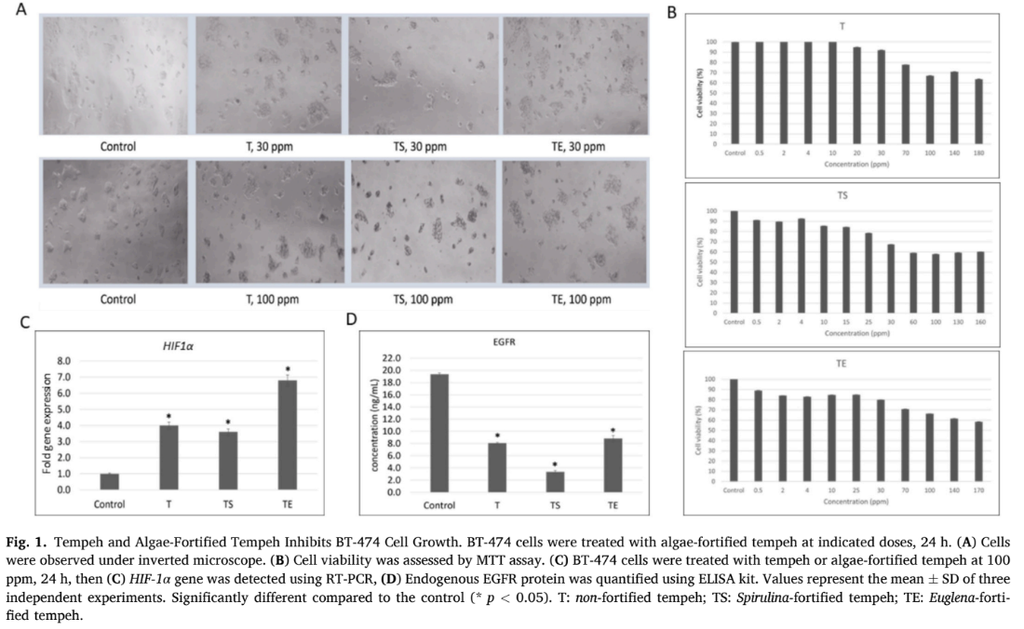
• Algae-fortified tempeh reduced cell viability by up to 60%, more than conventional tempeh.
• All extracts suppressed EGFR, induced S-phase arrest, and modulated the PI3K/AKT/mTOR pathway.
Key Results
•Extracts contained flavonoids, alkaloids, and high phenolic content.
•Algae-fortified tempeh reduced cell viability by up to 60%, more than conventional tempeh.
•All extracts suppressed EGFR, induced S-phase arrest, and modulated the PI3K/AKT/mTOR pathway.
Discussion & Conclusion
• Algae fortification is a food-biotechnology strategy for pathway-targeted cancer prevention.
• These are laboratory findings in cancer cells; they support complementary health applications.
Related SDGs
SDG 2: Zero Hunger – Innovation in nutritious functional foods
SDG 3: Good Health and Well-Being – Exploring food-based approaches to cancer prevention
Journal Information
Journal: Journal of Functional Foods



0 Comments