

Authors
Alma Lucyati 1,2, Deni Kurniadi Sunjaya 3, Gaga Irawan Nugraha 4,Dewi Marhaeni Diah Herawati 3, Dida Akhmad Gurnida4,5, Dedi Rachmadi5
Affiliations
1Doctoral Study Program, Faculty of Medicine, Universitas Padjadjaran, Bandung, Indonesia; 2 Department of Public Health, Faculty of Medicine, Universitas Pasundan, Bandung, Indonesia; 3 Department of Public Health, Faculty of Medicine, Universitas Padjadjaran, Bandung, Indonesia; 4 Department of Biomedical Sciences, Faculty of Medicine, Universitas Padjadjaran, Bandung, Indonesia; 5 Department of Pediatrics, Faculty of Medicine, Universitas Padjadjaran, Bandung, Indonesia
Background
• Health workers at community health centers (CHCs) and hospital experts may interpret low birth weight (LBW) and stunting data differently.
• This study used community-based nutrition reporting data (e-CBNRR) to compare their perceptions.
Methods
• Mixed-methods study.
• Quantitative: e-CBNRR data from 2020 to 2024, covering 715 children (287 LBW and 428 non-LBW) in 141 sub-districts.
• Qualitative: in-depth interviews analysed thematically, using the quantitative results as a starting point.
Key Results
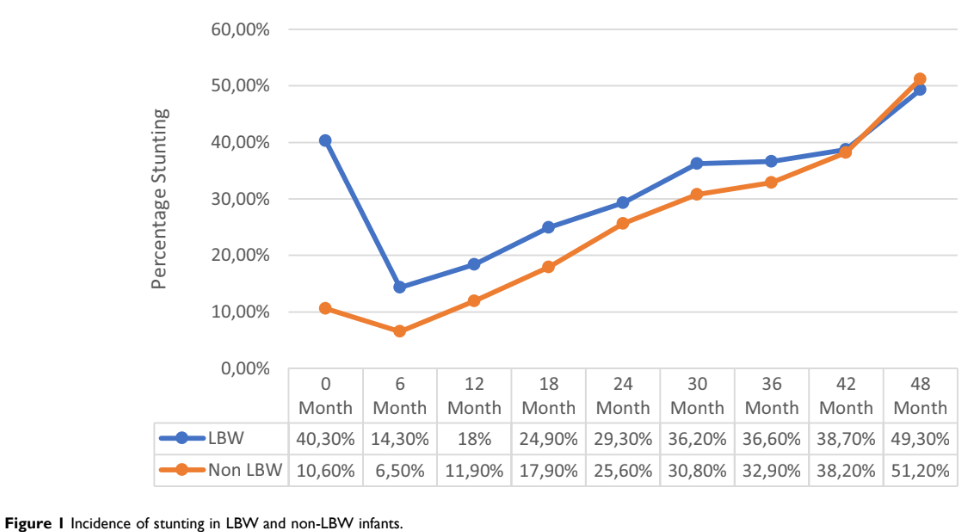
• Stunting at birth reached 40.30% in the LBW group versus 10.60% in the non-LBW group.
• In the LBW group, stunting fell to 14.30% at 6 months but rose again with age; in the non-LBW group it climbed to 51.20% at 48 months.
• CHC health workers had never conducted advanced analysis of e-CBNRR data and did not link the data to the interventions needed.
Discussion & Conclusion
• LBW babies had stunting rates about 4 times higher than non-LBW babies, and stunting declined during breastfeeding before rising again as children grew.
• Perceptions differ between CHC health workers and hospital experts; e-CBNRR data can help develop better-targeted interventions for LBW and stunting.
Related SDGs
SDG 2: Zero Hunger – Tackling child stunting and undernutrition
SDG 3: Good Health and Well-Being – Strengthening maternal and child health services
Journal Information
Journal: Journal of Multidisciplinary Healthcare




0 Comments