

Authors
Ratna Dewi Indi Astuti1,2,*, Anggraini Alam3,*, Mohammad Ghozali 4,*, Budi Setiabudiawan 3,5,*
Affiliations
1Doctoral Study Program, Faculty of Medicine, Universitas Padjadjaran, Bandung, West Java, 40161, Indonesia; 2 Department of Microbiology-Parasitology of Faculty of Medicine, Universitas Islam Bandung, Bandung, West Java, 40116, Indonesia; 3Department of Child Health of Faculty of Medicine, Universitas Padjadjaran & Hasan Sadikin General Hospital, Bandung, West Java, 40161, Indonesia; 4 Department of Biomedical Sciences of Faculty of Medicine, Universitas Padjadjaran, Bandung, West Java, 40161, Indonesia; 5 Faculty of Medicine, President University, Cikarang Bekasi, West Java, 17550, Indonesia
Background
• Dengue severity is shaped by viral load and the host’s immune response.
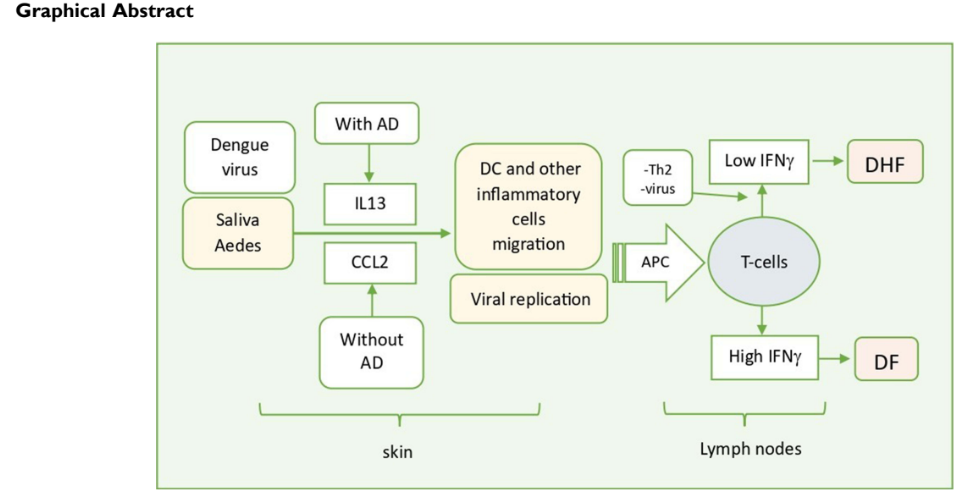
• Aedes aegypti saliva increases cell numbers at the bite site, which may promote viral replication.
• Atopic dermatitis (AD) involves hypersensitivity to Aedes saliva and a Th2-skewed immune response, and both AD and severe dengue are more common in children.
Methods
• Observational cross-sectional study of 62 children aged 1–12 years with secondary dengue.
• AD history was assessed with the ISAAC questionnaire.
• T-cell function was measured as IFNγ, IL-10, IL-13, and CCL2 levels in stimulated whole blood cultures, with and without Aedes aegypti salivary gland extract (SGE), using ELISA.
Key Results
• Dengue hemorrhagic fever (DHF) was more common in dengue patients with AD than in those without AD (p = 0.010).
• With SGE, CCL2 was higher in DHF than in dengue fever (p = 0.044), and IL-13 was higher in patients with AD (p = 0.026).
• Without SGE, IFNγ was lower in DHF than in dengue fever (p = 0.035).
Discussion & Conclusion
• AD may be linked to a higher incidence of DHF and greater T-cell IL-13 production in response to Aedes saliva.
• Higher CCL2 in DHF may reflect greater cell infiltration at the bite site, while lower IFNγ suggests a weaker T-cell response to dengue infection.
Related SDGs
SDG 3: Good Health and Well-Being – Understanding immune factors behind severe dengue in children
Journal Information
Journal: Journal of Inflammation Research



0 Comments