

Authors
Abed Ricky H. Sitompul1*, Tetty Yuniati2, Fiva Aprilia Kadi2, Aris Primadi2, Dwi Prasetyo2, Ahmedz Widiasta2, Ekawati L. Haksari3, Harry G. Nugraha4 and Antony A. Adibrata5
Affiliations
1Neonatology Sub-Specialist Program, Department of Child Health, Faculty of Medicine, Padjadjaran University, Bandung, Indonesia, 2Department of Child Health, Faculty of Medicine, Padjadjaran University/Dr. Hasan Sadikin General Hospital, Bandung, Indonesia, 3Department of Child Health, Faculty of Medicine, Gadjah Mada University, Sardjito General Hospital, Yogyakarta, Indonesia, 4Department of Radiology, Faculty of Medicine, Padjadjaran University/Dr. Hasan Sadikin General Hospital, Bandung, Indonesia, 5Faculty of Medicine, Padjadjaran University, Bandung, Indonesia
Background
• Acute kidney injury (AKI) predicts mortality in neonates, but serum creatinine rises only after kidney function is already lost.
• Late-onset neonatal sepsis (LONS) is a common trigger of AKI.
Methods
• Single-center prospective study in the NICU (July–August 2025) with 36 preterm neonates with probable LONS.
• Compared the renal resistive index (RRI) and nSOFA scores for predicting AKI risk, using the STARZ score for risk stratification.
Key Results
• Median RRI and STARZ scores rose during the course of LONS.
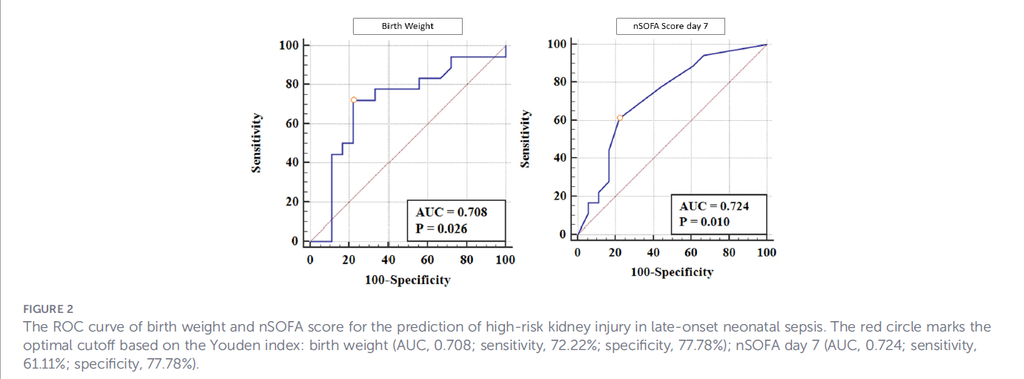
• Birth weight below 1,357 g and congenital heart disease were significant risk factors.
• An nSOFA score above 3 on day 7 was a strong independent predictor of high-risk AKI (OR 10.01).
Discussion & Conclusion
• Serial nSOFA monitoring may offer a practical way to identify AKI risk early in preterm neonates with LONS.
• These findings come from a small single-center study.
Related SDGs
SDG 3: Good Health and Well-Being – Protecting the health of premature newborns
Journal Information
Journal: Frontiers in Nephrology


0 Comments