

Authors
Lia Faridaha,*, Radja Azis Nurhakimb, Raden Roro Upiek Ngesti Wibawaning Astutic, Melanied, Enny Rohmawatia, Yenny Rachmawatie, Thaddeus Carvajalf
Affiliations
aDepartment of Biomedical Science, Faculty of Medicine, Universitas Padjadjaran, Bandung 40161, SSWJ, IndonesiabFaculty of Medicine, Universitas Padjadjaran, Sumedang 45363, SSWJ, IndonesiacFaculty of Biology, Universitas Gadjah Mada, Yogyakarta 55281, IndonesiadDepartment of Biology, Faculty of Mathematics and Natural Sciences, Universitas Padjadjaran, Sumedang 45363, IndonesiaeFaculty of Medicine, IPB University, Bogor 16680, SSWJ, IndonesiafDepartment of Biology, College of Science, De La Salle University, Manila 1004, Philippines
Background
• Mosquito repellents are key personal protection against mosquito-borne diseases.
• Their effectiveness varies by active ingredient, formulation, and mosquito species.
Methods
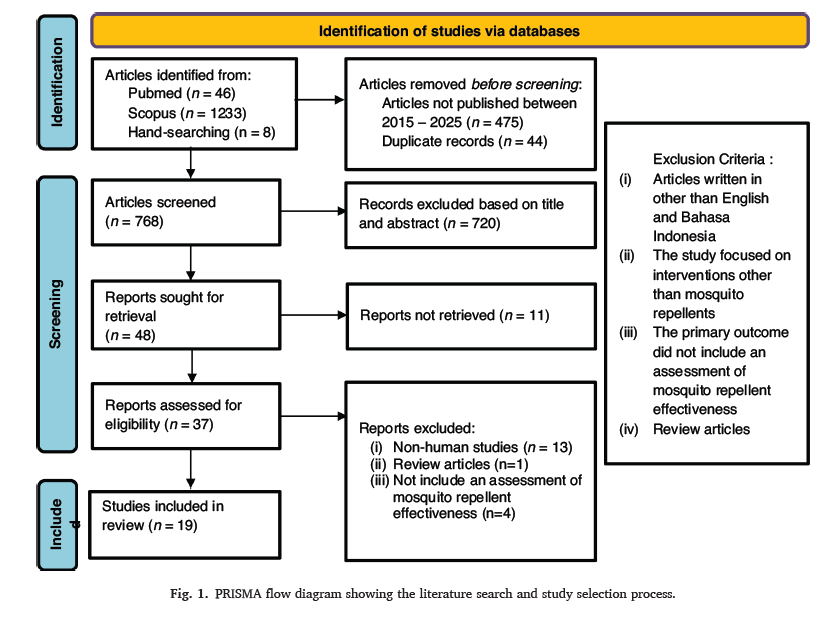
• Systematic review (PRISMA 2020) of human studies published 2015–2025.
• Scopus and PubMed searches found 1,287 records; 19 studies met the criteria.
• Protection time, repellency rate, and safety were synthesized descriptively.
Key Results
• DEET-based lotions and ointments gave the longest protection, often five to nine hours, with no reported skin reactions.
• Natural repellents (citronella, lemon eucalyptus, neem, lemongrass) usually protected for two to four hours.
• Microencapsulation and nanoemulsions improved some formulations; treated clothing and spatial repellents helped as complements.
Discussion & Conclusion
• Synthetic topical repellents remain the most reliable option for prolonged protection.
• Optimized plant-based products may be safer alternatives for short-term or adjunctive use.
Related SDGs
SDG 3 – Good Health and Well-Being
The study directly addresses chronic hepatitis B, liver fibrosis, disease monitoring, and the development of a predictive model to support clinical management.
SDG 9 – Industry, Innovation and Infrastructure
The research develops a non-invasive predictive model using IL-13, age, and platelet count to assess liver stiffness, with potential value where transient elastography is unavailable
Journal Information
Journal: Acta Tropica





0 Comments