

Authors
Herry Herman 1,2, Fathurachman Fathurachman 1,2
Affialitions
1Departement Orthopaedic Surgery and Traumatology, Faculty of Medicine Universitas Padjadjaran, Bandung, 40161, Indonesia; 2RS Unpad University Hospital, Jatinangor, 45363, Indonesia
Background
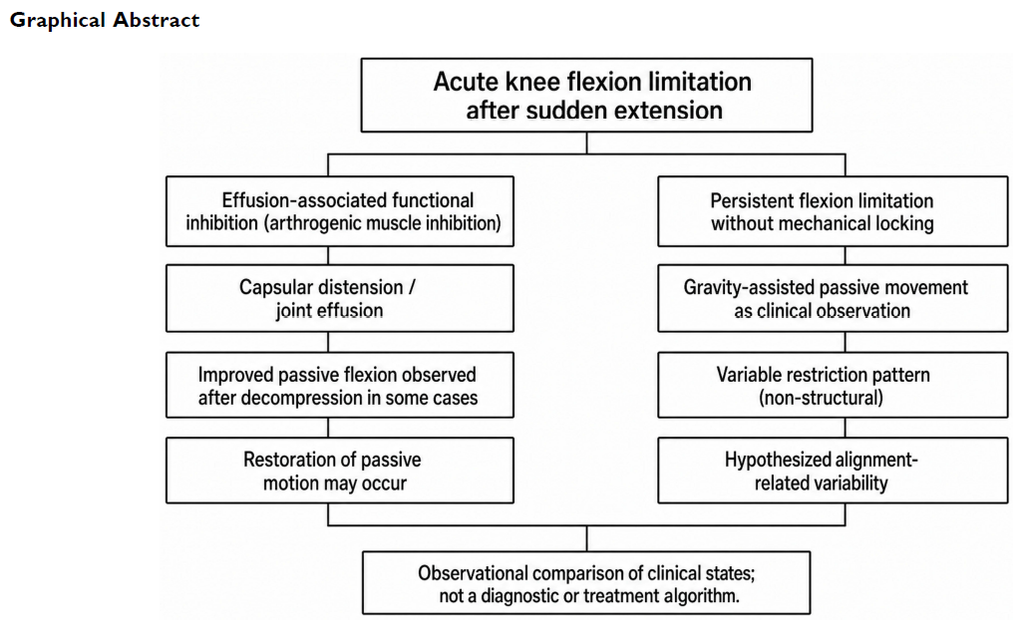
• Acute inability to flex the knee after a sudden extension event is usually attributed to structural damage.
• Some patients have non-mechanical limitation that resolves without invasive treatment.
Methods
• Narrative review and conceptual synthesis on arthrogenic muscle inhibition, knee effusion, and rotational knee biomechanics.
• Combined with clinical observations to build a bedside assessment framework.
Key Results
• A four-component framework: (1) aspirate knee effusion; (2) assess gravity-assisted passive flexion; (3) pain-limited, alignment-facilitated motion; (4) confirm restoration of symmetric motion.
Discussion & Conclusion
• Acute knee flexion limitation may not always reflect fixed mechanical obstruction.
• The framework is hypothesis-generating and needs prospective clinical validation.
Related SDGs
1. SDG 3 – Good Health and Well-Being
The article addresses an orthopedic clinical problem and proposes a framework to improve clinical assessment and management of acute knee flexion limitation. It aims to support clinical reasoning and potentially improve patient care, although the framework still requires prospective validation.
2. SDG 9 – Industry, Innovation and Infrastructure
The article presents a new conceptual clinical framework integrating effusion-mediated inhibition and rotational knee biomechanics. However, it does not develop a new medical technology, device, or infrastructure.
Journal Information
Journal: Orthopedic Research and Reviews





0 Comments