

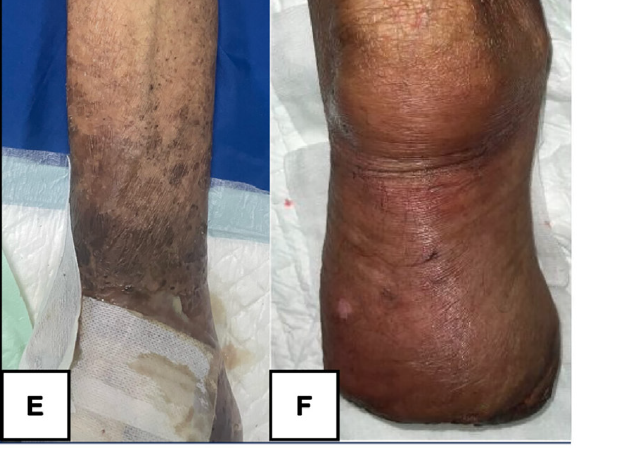
Figure 1. ( A–F) Charcot’s arthropathy and multiple ulcers (red arrows) on the right lower limb and lateral ankle (A); the sole of the foot and medial ankle (B); macroscopic appearance of the ulcers before transtibial amputation (C, D); and comparison of the lower limb before and after transtibial amputation (E = before; F = after).
A case report published in the International Journal of Infectious Diseases highlights the severe and potentially preventable consequences of treatment neglect in patients with multibacillary (MB) leprosy. The report, authored by researchers from the Department of Dermatology and Venereology, Faculty of Medicine, Universitas Padjadjaran and Dr. Hasan Sadikin Hospital, Bandung, describes a case in which prolonged treatment neglect led to severe infection, osteomyelitis, and ultimately transtibial amputation.
Authors
Hendra Gunawan,Kartika Ruchiatan ,Erda Avriyanti ,Risa Miliawati Nurul Hidayah , Devina Gracia Pratama
Affiliations
Department of Dermatology and Venereology, Faculty of Medicine, Universitas Padjadjaran – Dr. Hasan Sadikin Hospital, Bandung, West Java, Indonesia
Background
Leprosy is a chronic infectious disease caused by the Mycobacterium leprae complex that primarily affects the skin and peripheral nerves. Although effective multidrug therapy (MDT) is available, leprosy continues to contribute to preventable disability, particularly in endemic countries, including Indonesia.
Multibacillary leprosy is associated with a high bacterial load, extensive skin lesions, and significant peripheral nerve involvement. Without timely treatment and appropriate follow-up, progressive nerve damage may result in sensory loss, repeated unnoticed trauma, neuropathic ulcers, secondary infection, and permanent disability.
The case report emphasizes that severe disability may arise not only from delayed diagnosis, but also from failure to initiate and maintain appropriate treatment.
Methods
The publication presents a clinical case involving a 66-year-old man who had experienced hypopigmented, anesthetic skin lesions and numbness in his hands and feet for approximately two years. Despite previous advice to undergo further evaluation for suspected leprosy, the patient declined referral and did not receive antileprosy treatment.
A comprehensive clinical assessment was performed, including physical and neurological examinations. Radiological imaging, wound cultures, slit-skin smear examination, and histopathological assessment were also conducted to establish the diagnosis and assess the extent of the complications.
The patient was diagnosed with advanced multibacillary leprosy within the lepromatous spectrum, complicated by neuropathic ulcers, Charcot arthropathy, secondary bacterial infection, and acute osteomyelitis. Treatment included multibacillary multidrug therapy, broad-spectrum intravenous antibiotics, wound management, and surgical intervention.
Key Result
The clinical examination revealed multiple manifestations of advanced leprosy, including diffuse anesthetic skin patches, peripheral nerve thickening, glove-and-stocking sensory loss, claw-hand deformities, thenar atrophy, and madarosis. A deep plantar ulcer and multiple infected ulcers were identified on the right lower limb, accompanied by Charcot arthropathy.
Radiological examination demonstrated extensive soft-tissue swelling, bone destruction, acro-osteolysis, and gas formation, indicating acute osteomyelitis complicated by a gas-forming infection. Wound cultures identified Staphylococcus aureus and Klebsiella pneumoniae.
The slit-skin smear demonstrated abundant acid-fast bacilli, with a bacteriological index of 5+ and a morphological index of 90.7%. Histopathological findings were consistent with lepromatous-spectrum leprosy.
Although antimicrobial therapy and wound management were initiated, the extensive infection involving the foot, ankle, and distal lower leg posed a significant risk of sepsis. Consequently, transtibial amputation was performed to achieve adequate infection control. Following surgery, the patient’s condition improved, and he was referred for rehabilitation and prosthetic assessment.
Discussion & Conclusion
The case illustrates the serious consequences that can occur when multibacillary leprosy remains untreated for an extended period. Peripheral neuropathy can cause loss of sensation, making patients vulnerable to repeated unnoticed trauma and the development of neuropathic ulcers. When these wounds are not adequately monitored and treated, they may progress to severe infection and osteomyelitis.
In this case, treatment neglect played a central role in disease progression. The authors highlight that advanced disability in leprosy is influenced not only by delays in diagnosis, but also by delayed treatment initiation, poor continuity of care, inadequate follow-up, limited awareness, and stigma.
The case therefore reinforces the importance of early recognition, timely initiation of multidrug therapy, continuous patient engagement, appropriate wound care, and long-term follow-up. These measures are essential to prevent irreversible disability and reduce the need for major surgical interventions such as amputation.
The authors conclude that the severe complications experienced by the patient were largely preventable through earlier intervention and sustained treatment.
Related Sustainable Development Goals (SDGs)
This publication is particularly relevant to the following Sustainable Development Goals:
SDG 3 – Good Health and Well-being
The study supports efforts to improve the prevention, early detection, treatment, and management of infectious diseases and their complications, while reducing preventable disability.
SDG 10 – Reduced Inequalities
Leprosy can be associated with disability, stigma, and barriers to healthcare. Strengthening access to diagnosis, treatment, rehabilitation, and continuous care can contribute to reducing health-related inequalities.
SDG 17 – Partnerships for the Goals
Effective leprosy control requires collaboration among healthcare professionals, health institutions, public health programs, rehabilitation services, patients, families, and communities.
Among these goals, SDG 3 is the most directly aligned with the focus of the case report.
Journal Information
Article Title: Treatment neglect in multibacillary leprosy leading to osteomyelitis and transtibial amputation: Lessons from endemic setting
Authors: Hendra Gunawan, Kartika Ruchiatan, Erda Avriyanti, Risa Miliawati Nurul Hidayah, and Devina Gracia Pratama
Journal: International Journal of Infectious Diseases
Volume: 164
Year: 2026
Affiliation: Department of Dermatology and Venereology, Faculty of Medicine, Universitas Padjadjaran – Dr. Hasan Sadikin Hospital, Bandung, West Java, Indonesia
DOI: 10.1016/j.ijid.2025.108354






0 Comments